
recoating education
Hardwood Floor Cupping vs. Crowning: Next Steps
Cupping raises board edges; crowning raises the center. Find the moisture cause and confirm stability before sanding or adding a new finish.
Cupping raises the edges; crowning raises the center
Cupping and crowning describe different board shapes. With cupping, the sides of an individual board sit higher than its center. With crowning, the center sits higher than the sides.
Neither shape is a problem that a new coat of finish can flatten. Before discussing sanding, find the cause of the movement and establish whether the floor is stable.
The NWFA installation guidelines define these conditions. A name helps describe what you see, but it is not a complete diagnosis.
Look across individual boards, not just across the room
A sloping room or an uneven subfloor is not automatically cupping. Look at the profile across each affected board. Light crossing the floor can make small changes more visible, though photographs can exaggerate them too.
Note whether the condition affects a few boards, an entire room, or the area near a water source. Record when you first noticed it and whether it changes with weather or climate control.
Do not pour water on the floor, pull up boards, or sand a test patch to confirm a guess. Those actions can alter the evidence or create additional damage.
The moisture source may be above or below
A leak, damp subfloor, crawl-space condition, indoor environment change, or another source may be involved. A floor professional needs the history as well as measurements appropriate to the construction.
NWFA prevention guidance explains that wood responds to moisture gain and loss. Our summer humidity guide covers room conditions, but a normal room reading does not exclude moisture beneath the floor.
Tell the inspector about recent plumbing work, appliance leaks, HVAC interruptions, flooding, or changes in basement conditions. A small event that seemed unrelated can be useful context.
Why immediate sanding can be the wrong repair
Sanding removes material according to the shape the floor has today. If that shape later changes as the wood dries or conditions stabilize, the sanded profile may no longer be appropriate.
That is why “we can make it flat tomorrow” is not the answer to seek before moisture evaluation. You want the cause corrected, the condition monitored as needed, and the repair chosen for the stable floor.
A floor may improve, need sanding, require board replacement, or have another outcome. No remote article can guarantee which one applies.
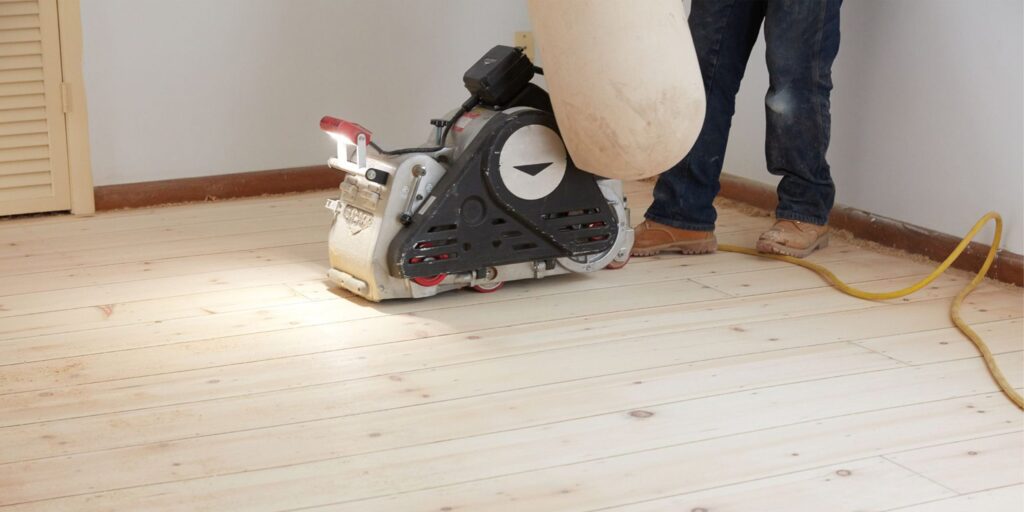
Sanding comes after the cause of board movement has been addressed. It should not be the first response to a wet floor.
Separate the investigation from the finish estimate
Ask for a clear explanation of what will be measured, which areas will be inspected, and what evidence supports readiness for restoration. If another trade must repair a leak or building condition, include that step before cosmetic work.
Bruce’s hardwood FAQ provides construction and humidity context. The appropriate limits still come from the actual flooring product and installation.
Do not confuse lack of visible water with a resolved moisture problem. Nor should a dry-looking surface be the only reason to proceed.
Once stable, the remaining material matters
If sanding and refinishing is appropriate, the floor must have enough usable material for the work. Prior sanding, engineered veneer, board condition, and the depth of distortion all affect that decision.
Our engineered-floor guide explains the construction issue. Our ReCoat-versus-refinish guide explains why a maintenance coat cannot substitute for reshaping or repair.
A stable floor may still show damage that cannot be removed reasonably. Agree on those limits before choosing the final finish or stain.
Describe the condition clearly when asking for help
Send a wide room photo and low-angle views showing the board profile. Note the location, when it appeared, and any suspected water event. If you have indoor readings, include them as context without treating them as a complete moisture test.
When you contact ReCoat Revolution, start with the movement, not a request to make the floor shiny. We can help identify which assessment belongs ahead of a finish service and whether restoration is the right next step.