
wood floor care
Water Spilled on Hardwood? What to Do First
Remove standing water promptly, stop the source, and check joints and nearby materials. Learn when a wood-floor spill needs professional assessment.
Remove the water, then find where it went
Pick up standing water on hardwood promptly with clean absorbent material. Stop the source if it is safe, move wet objects away, and check the surrounding joints and surfaces.
A small spill that is removed quickly is different from a dishwasher leak or water that has traveled beneath the floor. Do not use the same cleanup assumption for both.
There is no dependable rule that water is harmless for a certain number of minutes. Finish condition, gaps, construction, and the amount of water all change the situation.
Do not stop at the visible puddle
Look beside cabinets, beneath a movable mat, and around the edge of the spill. Water can collect where a cloth does not easily reach.
Record what happened and take photos before moving damaged items, when practical. For a continuing leak or widespread water, arrange appropriate leak repair and moisture assessment. If electrical equipment is involved, keep clear of the affected area and use qualified help.
The NWFA maintenance guidance advises prompt spill cleanup. That everyday instruction is not a complete drying plan for an affected floor assembly.
Let assessment guide the drying plan
A floor that looks dry at the surface may still have moisture elsewhere. The right response depends on the materials involved and where the water traveled.
Do not aim intense heat at one patch, steam the surface, or assume a household fan proves everything below is dry. A professional can assess moisture and decide whether additional drying or material removal is needed.
If boards begin changing shape, our cupping-versus-crowning guide explains those terms. Neither condition should be diagnosed from appearance alone without considering moisture.
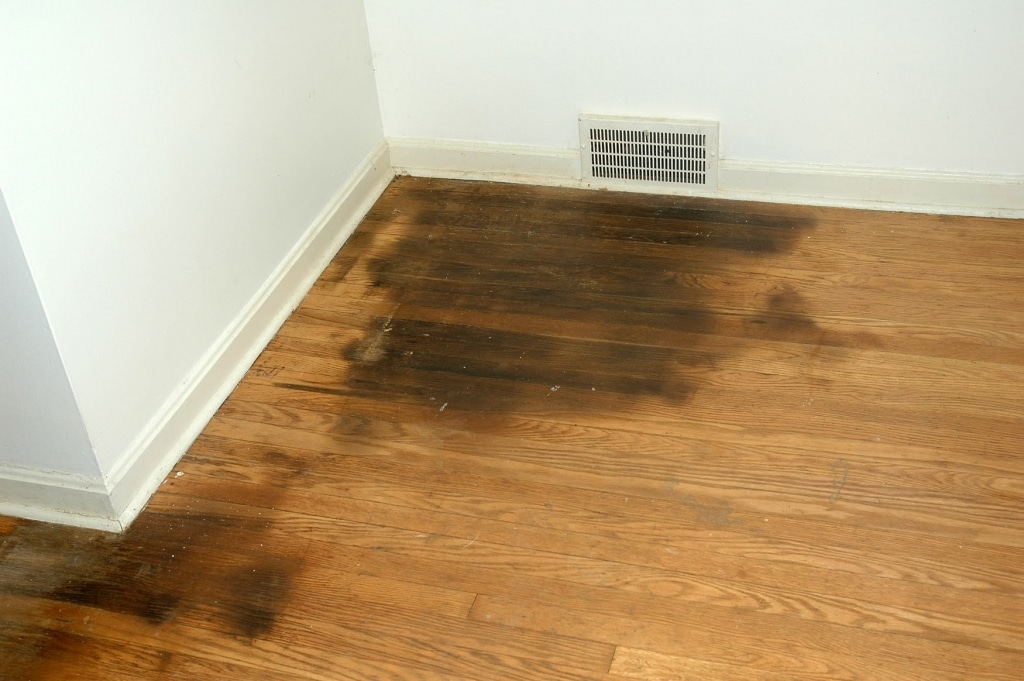
Visible staining is only one part of a moisture assessment. The source and condition beneath the surface must be considered.
A remaining mark is a second decision
After the moisture issue is resolved, assess any lasting stain, haze, roughness, or finish failure. The mark may be in the coating, the wood, or deeper in the assembly.
Bona’s water-stain guidance distinguishes cleanup from a remaining stain problem. A finish-specific remedy may be appropriate, but do not apply a chemical recipe to an unidentified surface.
Our white-spot guide covers one visible symptom. A pale mark and a deeply darkened board do not necessarily call for the same treatment.
Finish work comes after the floor is stable
A maintenance coat cannot dry wood or correct distorted boards. Sanding should not be used to flatten a floor that is still changing with moisture.
Once the cause is corrected and the condition is stable, discuss whether cleaning, finish repair, sanding, or board replacement fits the remaining damage. Ask what evidence supports that recommendation.
Contact ReCoat Revolution with the source of the water, the affected area, photos, and any drying or moisture-assessment records. We can help evaluate the restoration step after the moisture problem has been addressed.