
wood floor care
White Spots on Hardwood Floors: What Are They?
White marks on hardwood may sit in residue, polish, or finish. Diagnose the layer before trying heat, abrasives, or another coat to hide the spot.
White spots are a clue, not a diagnosis
A white mark on hardwood can come from surface residue, a changed polish layer, moisture affecting a coating, or damage to the finish itself. Do not choose a repair from the color alone.
Start with what happened just before the mark appeared. A spilled drink, a damp planter, a cleaner left to dry, and a recently applied polish are different histories. They may require different responses even when the photos look similar.
Ask three questions before touching the spot
Is anything still wet? Remove visible moisture and investigate an ongoing source. A leaking planter or pet bowl can keep repeating the problem while you focus on the mark.
What products are on the floor? Include polish and restorer, not only the latest cleaner. An added layer may react differently from the original finish.
Did the spot appear after recent coating work? If so, ask the installer to inspect before applying cleaners or household treatments.
Bona’s cloudy-floor guidance lists several explanations for a pale appearance. Its existence is a reminder to diagnose, not permission to apply every suggested method to every finish.
Use the shape and location as context
A ring below a container suggests a different event from parallel mop streaks. A mark under a rug may have a different history from a pale path beside a window. Record those differences in photos.
Look from more than one angle. A surface that appears white in reflected light may look normal from above. A real color change may remain visible from several directions.
Do not keep wetting the spot just because it temporarily looks better while damp. That can mask the appearance without resolving the affected layer.
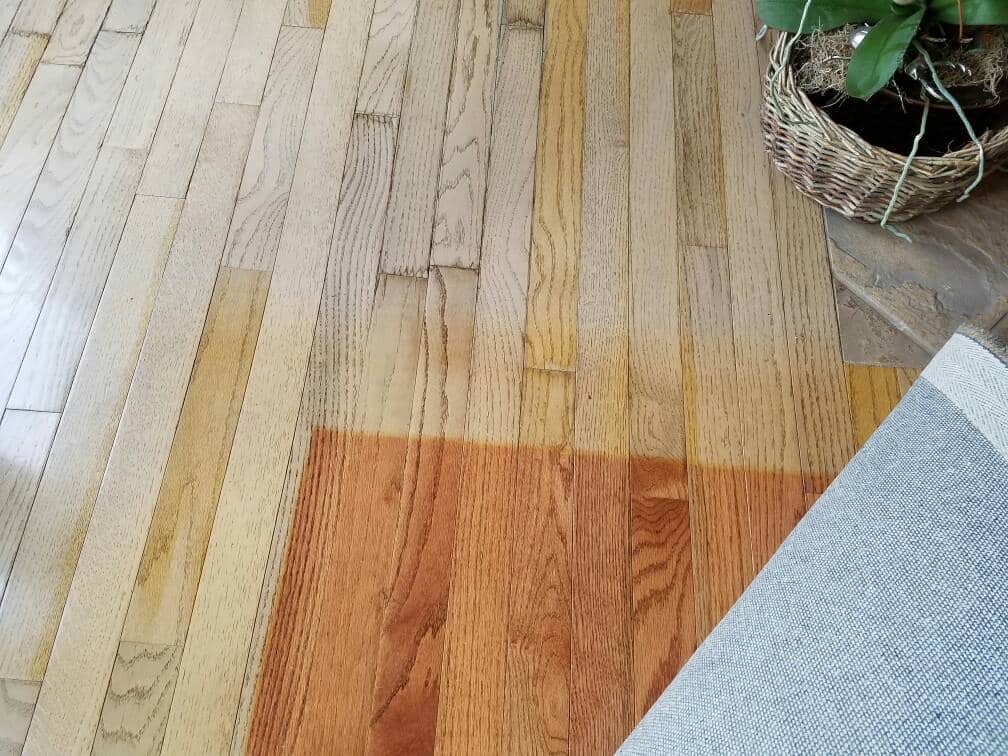
Pale areas can look similar while having different causes. Check the history and finish before choosing a treatment.
Try a compatible cleaning method only when it fits
If the floor has an older, sound finish and the mark appears to be surface soil, use the manufacturer-approved cleaner in a small area. Follow the directions, avoid excess liquid, and inspect after drying.
Bruce’s spot-care guidance separates particular cleaning situations. Read it alongside your own flooring instructions, rather than transferring a method from a different product.
If the mark stays, stop increasing the strength or abrasiveness. The cloudy-floor article explains the larger diagnosis. The sticky-floor article is useful when the pale area also feels tacky.
Leave the furniture-repair tricks on the internet
We would not use toothpaste, a hot iron, a hair dryer, or a harsh scrubbing pad on an unknown floor finish. A trick intended for one small furniture surface does not establish compatibility with a finished floor.
The risk is not only making the white spot larger. You can create a different sheen, cut through the coating, or move contamination into an area that later needs professional preparation.
The NWFA finish guide shows why finish identification belongs ahead of a remedy. When you cannot establish what is on the surface, there is no sensible universal household recipe.
Match the treatment to the layer
Surface soil may respond to professional cleaning. An identified added coating may need acrylic or wax removal. Damaged original finish or discoloration below it requires a restoration assessment.
A ReCoat does not automatically conceal a white mark. A clear protective layer can leave the same mark visible underneath. Our ReCoat-versus-refinish guide explains the difference in depth.
For pale outlines related to sunlight or rugs, read faded-floor repair instead of assuming water is responsible.
If the spot persists, contact ReCoat Revolution with its history, product names, and photos taken both straight down and across the light. That helps us discuss the likely next step without pretending a picture is a complete diagnosis.