
wood floor care
Why Are Hardwood Floors Sticky After Cleaning?
Sticky hardwood floors can mean excess cleaner, dirty pads, old polish, or a soft finish. Find the cause before mopping again or adding another product.
Sticky hardwood floors need diagnosis, not a stronger mixture
A hardwood floor that feels sticky after cleaning may have excess cleaner, redistributed dirt, an old polish layer, or a finish that is not hard yet. Start with when the tackiness appeared. Do not keep adding products until one makes it feel different.
The first split is simple: was the floor recently coated, or was it only cleaned? Fresh finish belongs in a conversation with the installer. An older floor that changed after mopping needs its cleaning history checked first.
Match the pattern to the next question
| What you notice | Ask this next | Avoid doing this |
|---|---|---|
| Sticky tracks follow the mop | Was the pad dirty or solution too strong? | Another stronger pass |
| Tackiness concentrates near cooking areas | Is there grease or repeated spot-cleaner use? | Abrasive scrubbing |
| The whole surface has a shiny film | Was polish or restorer applied? | Covering it with finish |
| A newly coated floor feels soft | What does the installer say about cure? | Washing or covering it |
| One area stays damp or changes shape | Is moisture reaching the floor? | Treating it as ordinary residue |
These are starting questions, not tests that prove a cause. Several problems can exist in the same room.
Reconstruct the last cleaning session
Find the bottle and read the exact name. Was it a concentrate, a ready-to-use cleaner, or a product that promises shine? Did someone replace the refill, change the dilution, or use a pad washed with a different laundry product?
Write down what happened before the floor became sticky. Include old polish even if it was applied months ago. Basic Coatings’ maintenance checklist treats that product history as part of assessing a floor.
If Pine-Sol was involved, our Pine-Sol guide explains why the exact formula and surface restrictions matter. For Bona, read cleaner versus polish before assuming the bottle was only a cleaner.
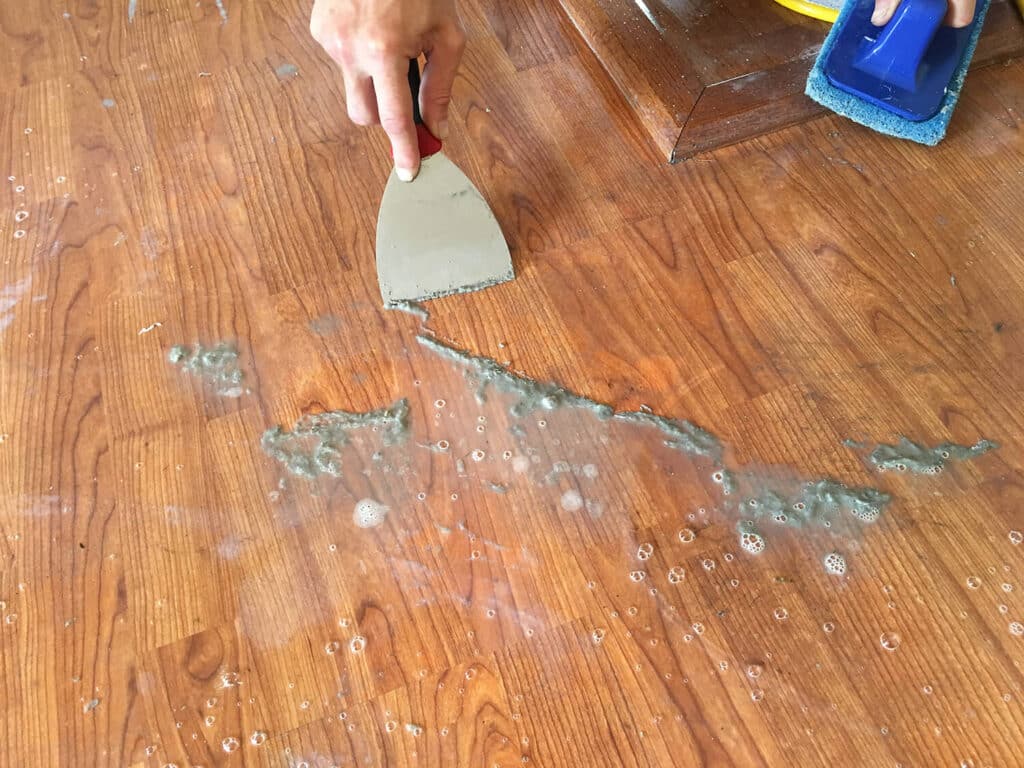
Professional removal of surface material. Ordinary cleaner residue does not automatically require this level of treatment.
Try less, in a smaller area
On an older, sound finish, remove loose soil first. Then use only the cleaner and method approved for that surface. Test a small inconspicuous area with a clean pad and inspect it after drying.
Do not flood the floor to rinse it. Do not add a second household chemical to “neutralize” the first. Do not use an abrasive pad to force the tackiness off. Those choices can turn a removable layer into a damaged finish.
If the approved method helps, work in small sections and change pads as they collect soil. If it leaves the same sticky feeling, stop. The remaining material may not be ordinary dirt.
Bona’s discussion of cloudy floors describes several residue and moisture causes. Appearance and touch need to be considered together. Our cloudy-floor article addresses the visual side without assuming every haze is sticky residue.
Fresh finish gets a different response
If the floor was just ReCoated or refinished, call the crew before applying cleaner. Report when the work ended, the indoor conditions, and whether the problem is everywhere or isolated.
A surface may be dry enough for limited use before it reaches full resistance. That does not make persistent softness normal. The exact product and application history determine the next step. Our aftercare guide explains the difference between dry and cured.
Keep rugs and heavy traffic off a questionable coating until the contractor gives direction. A cleaning experiment can obscure the evidence they need.
Cleaning, removal, and repair have different limits
Professional cleaning can address surface soil. Acrylic and wax removal addresses identified coatings that need a separate process. Neither guarantees the finish underneath is ready for another coat.
The NWFA refinishing guidance distinguishes deeper restoration needs. Bare wood, deep stains, and failed finish need an assessment beyond whether the floor feels clean.
For a useful first conversation, contact ReCoat Revolution with product photos, the timing of the problem, and a few floor photos. Tell us whether it is sticky, cloudy, soft, or some combination. Those words describe different clues.