

product comparisons
Can You Use Pine-Sol on Hardwood Floors?
Pine-Sol allows use on certain sealed wood floors. Learn the exclusions, why finish condition matters, and what we recommend for everyday cleaning.
Pine-Sol on hardwood floors: the label has conditions
Yes, Pine-Sol permits use on certain sealed wood floors. That does not make it the right cleaner for every hardwood floor, and it is not our first choice when the finish is unknown. We recommend the cleaner specified for your floor or finish system.
The important word is sealed. A floor can look shiny while the finish near the sink, back door, or dog bowl is worn through. A product approved for intact finish does not automatically become appropriate for those exposed spots.
Pine-Sol’s own FAQ excludes unfinished, unsealed, waxed, oiled, and worn wood, among other surfaces. Those exclusions deserve as much attention as the front-label promise.
Start with the floor, then choose the bottle
Before you mop, look for the flooring paperwork or the name of the finish applied during its last service. You are cleaning the protective surface above the wood. Different finishes need different care.
If you cannot identify the finish, do not run a wet experiment across the entire room. Photograph the floor in daylight, including traffic lanes and areas near water. Keep the cleaner bottle handy so a flooring professional can see the exact product.
Look for gray or rough patches, peeling edges, dark seams, and spots that stay dull after ordinary cleaning. None is a diagnosis by itself. Each is a reason to stop treating the whole floor as a uniformly sealed surface.
For the broader product picture, our cleaners-to-avoid guide explains why household cleaner, oil soap, and shine products are not interchangeable.
More cleaner does not mean a cleaner floor
Pine-Sol’s hardwood instructions distinguish concentrated and older formulas. Do not borrow a dilution recipe from an old video or a different bottle.
If the floor and product instructions allow use, follow that exact label. Remove loose grit first. Use a clean pad and keep liquid from collecting at seams. Do not pour cleaner directly onto a questionable patch to see whether it will improve.
A dirty pad keeps moving yesterday’s grime around the room. Too much cleaner can also leave something behind. When the floor dries sticky, repeating the same stronger mixture is a poor next move.
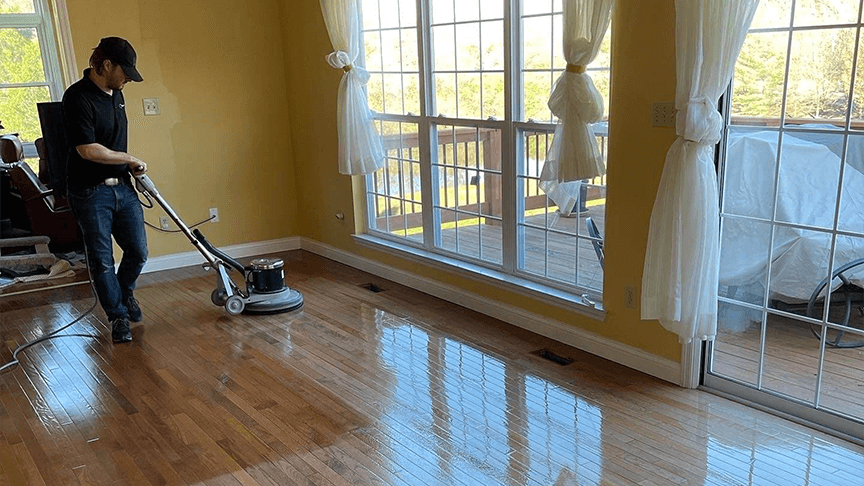
Professional surface preparation is a separate job from routine cleaning. A cleaner choice alone does not tell us which service a floor needs.
“I have used it for years. Is my floor ruined?”
Not necessarily. We would not recommend sanding a floor merely because someone used a particular cleaner. The condition of the floor matters more than a brand name in the cleaning cupboard.
Ask what changed. Did the problem appear after a new bottle, a stronger mixture, a new mop, or a polish application? Is it sticky everywhere or only around the kitchen? Does it look cloudy only in reflected light?
Those details help separate residue from finish wear. Our cloudy-floor guide covers appearance changes. The Murphy cleaner-versus-soap comparison shows why an exact product name matters.
Do not try to cancel one cleaner with vinegar, bleach, ammonia, or another household chemical. Mixing products creates a new problem and makes the original residue harder to identify.
Our everyday recommendation is deliberately boring
Choose a compatible hardwood cleaner, remove grit, use a clean microfiber pad, and apply only what the directions require. The NWFA maintenance guidance supports choosing cleaner for the actual finish.
A clean floor does not need to smell strongly or look wet. It also does not need a new glossy film every week. For a workable routine, see our professional cleaning method.
When routine cleaning no longer removes the residue, professional wood-floor cleaning can help establish what remains. If the finish is intact but worn, a Clean ReCoat evaluation is a separate conversation. Deep stains or exposed wood need a different repair plan.
Send photos of the affected areas and the front and back of your cleaner bottle when you contact ReCoat Revolution. We can start with the actual floor instead of guessing from the product name.