
buyer guides
Which Rug Pads Are Safe for Hardwood Floors?
Choose rug pads by floor-finish compatibility, not a generic hardwood-safe label. Check backing, trapped moisture, grit, and cure time before covering wood.
A rug pad is safe only when it suits the finish beneath it
Choose a rug pad that is non-staining and compatible with your actual hardwood finish. Do not rely on “hardwood safe” as a complete specification. The floor’s instructions and the pad maker’s instructions both matter.
A pad has several jobs: reduce slipping, cushion the rug, and protect the floor. It should not create a new problem by trapping moisture, shedding grit, or reacting with the coating.
Read the exclusions before the reviews
Bruce’s hardwood FAQ advises breathable, non-staining materials and excludes certain backings. That is one manufacturer’s guidance, not proof that every floor has the same requirements.
Ask the pad maker which finishes the product is intended for and whether it is suitable over a recently coated floor. If the answer is only a broad compatibility slogan, keep looking for the actual care information.
Save the packaging or product page. If a problem develops later, knowing the backing material is more useful than remembering that the pad had thousands of positive reviews.
Start with a fully ready floor
New finish needs time before it is covered. Permission for sock-foot traffic does not necessarily mean permission for a rug and pad to sit over it.
Follow the contractor’s schedule for the exact coating and room conditions. Our return-to-use guide explains the difference between drying and curing.
Do not set the rug down “just for the party” before the allowed date. Covering a questionable coating can create a more difficult problem than waiting to finish the room.
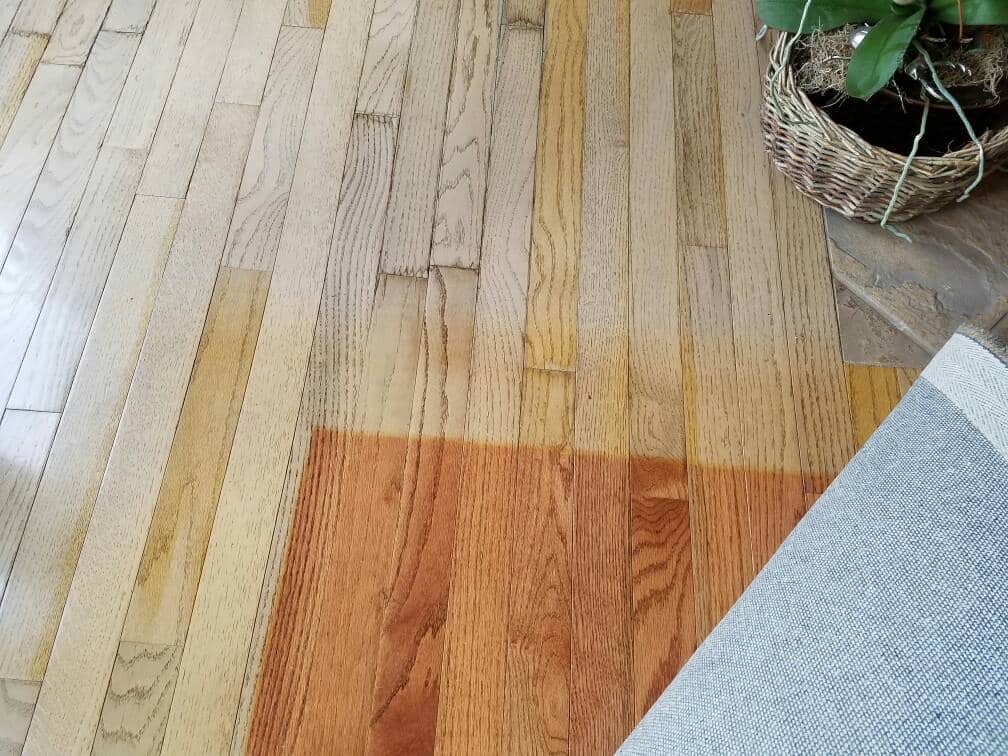
A rug outline can reflect uneven light exposure. It does not automatically mean the pad damaged the finish.
Fit matters too
Choose a pad that supports the rug without protruding into the walking path. A bunched edge can create a trip risk, while a sliding rug does little to protect a dog’s turning route or a busy hallway.
Follow the rug and pad manufacturer’s fitting instructions. Avoid improvising with adhesive tape directly on the floor unless the finish manufacturer expressly allows that product and use.
For rooms with rolling chairs or heavy furniture, a rug pad is not a substitute for a suitable load or movement-protection plan. Read our maintenance guide for the wider floor-care context.
Inspect the space you cannot see
Lift the rug periodically and check for grit, moisture, residue, or a backing that is becoming brittle or sticky. Clean both the floor and the rug underside as their instructions allow.
After a spill or pet accident, check underneath promptly. A dry rug surface does not prove the floor beneath it is dry. Keep bowl areas and exterior entries on your inspection list.
NWFA maintenance guidance supports prompt spill removal. Bona’s care brochure provides additional routine-care context. The practical point is simple: protection that hides dirt and moisture can become part of the problem.
A rug outline is not always a pad reaction
If the wood under the rug differs in color, consider light exposure before blaming the backing. Covered and uncovered areas age differently. Our sun-protection guide explains how to reduce that contrast.
If the surface feels sticky, carries an imprint, or changes sheen, note that separately. Do not scrub the whole rectangle with a stronger cleaner. The affected layer must be identified first.
Our faded-floor repair guide discusses existing outlines. A clear maintenance coat will not automatically remove a color difference inside the wood.
Choose prevention and repair separately
A ReCoat may improve a worn but sound finish. It cannot undo every backing reaction, flatten an imprint in soft material, or erase deep discoloration. Those conditions need individual assessment.
If you found a mark under a rug, contact ReCoat Revolution with photos of the floor and the pad label. Tell us whether the floor was recently coated and whether moisture reached the area. That information helps us distinguish an appearance issue from a coating problem.