
recoating education
Can You ReCoat Prefinished Hardwood Floors?
Prefinished hardwood can sometimes be ReCoated, including certain aluminum-oxide finishes. Product identification, preparation, and adhesion testing decide.
Prefinished hardwood needs a finish-specific answer
Some prefinished hardwood floors can be ReCoated. The right answer depends on the factory finish, the products applied since installation, and the preparation system proposed for the job.
A clean-looking floor does not prove a new coating will bond. Nor does the phrase aluminum oxide automatically mean the only option is replacement. Both shortcuts skip the information that matters.
Three labels that answer different questions
Solid or engineered describes the board’s construction. Prefinished means its finish was applied before installation. Aluminum oxide describes a component used in some factory finish systems.
These terms can overlap. A floor can be engineered, prefinished, and have an aluminum-oxide-containing coating. Another prefinished floor can be solid wood with a different system.
Bruce’s prefinished-floor guide describes factory finishing. The NWFA floor-types page addresses board construction. Keep those two questions separate when comparing repair advice.
Find the identification before renting equipment
Look for an invoice, an unopened carton, a product label on spare boards, or installation paperwork. A manufacturer and product line can help locate maintenance and warranty instructions.
If those records are gone, say so. The contractor may need to inspect and test rather than treating a guess as a specification. Do not sand a conspicuous area yourself just to identify what is underneath.
Also disclose every polish, restorer, wax, or previous finish application. The surface a contractor encounters today may no longer be only the original factory coating.
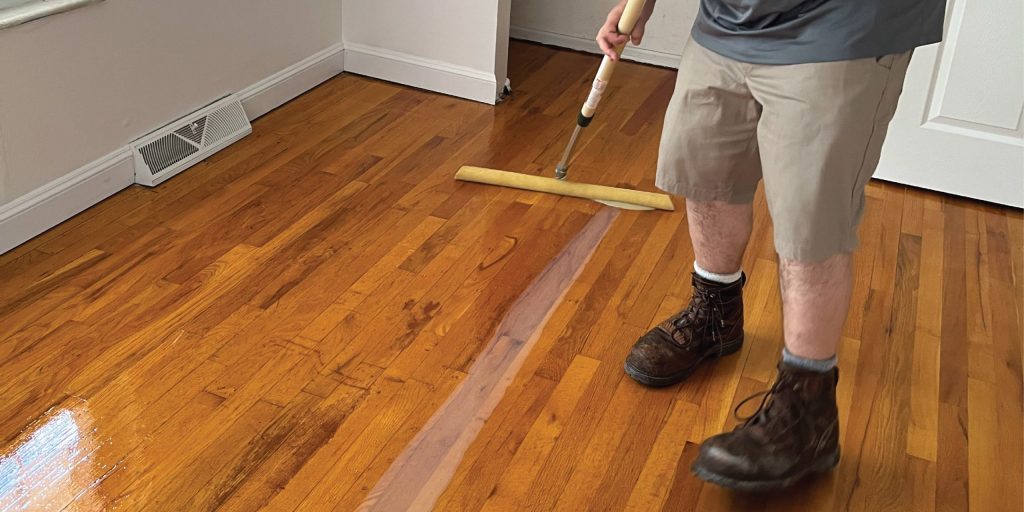
Finish application follows preparation. A factory-coated floor needs its own compatibility assessment first.
Why an ordinary buff may not be enough
Preparation has to produce the surface required by the new coating system. A hard factory finish can need a different approach from a worn site-applied coating. Contamination adds another variable.
Basic Coatings’ care guidance discusses a bonding approach for certain aluminum-oxide factory finishes. That establishes an option worth investigating, not universal permission to use the same process on every prefinished floor.
Ask the contractor to explain the cleaning, preparation, test, and finish as one system. “We use a good polyurethane” answers only one part of the question.
Our buff-and-coat article explains why service names can hide different preparation standards. A low price attached to a familiar name is not proof that the surface has been assessed.
A test needs a clear purpose and acceptance standard
The contractor should use the test process required for the proposed system and interpret the result before proceeding. Ask what failure would look like and what happens if the test does not pass.
Do not turn a household tape test into a guarantee. Location, preparation, cure, and the coating being tested all affect what the result means. Our qualification guide is a conversation starter, not a substitute for the system’s requirements.
If the surface is already peeling, the weak layer must be addressed. A new finish that bonds to a loose layer can still leave with that layer.
What the service will preserve
ReCoating preserves the existing floor profile. Beveled edges, handscraped texture, dents, and deeper scratches may remain. That preservation can be desirable, especially when removing more material would compromise the design or construction.
Be specific about the result you want. A new sheen is different from a flat, newly stained surface. Our sheen-change guide addresses the first goal. Our engineered maintenance guide covers the added importance of protecting a limited veneer.
When we would stop at assessment
Unresolved moisture, loose finish, unknown compatibility, or damage through the surface can make a maintenance coat the wrong choice. The inspection should identify those limits before the room is cleared and the finish is opened.
For a ReCoat evaluation, contact ReCoat Revolution with any product records and daylight photos. Include the words prefinished or aluminum oxide if they appear in the paperwork. Those details help us choose the questions and tests that belong to your floor.