
recoating education
ReCoating Engineered Hardwood Without Sanding
Engineered hardwood may qualify for ReCoating without sanding the veneer. Check finish compatibility, contamination, and damage before choosing the service.
Engineered hardwood can have a maintenance path without sanding away wood
An engineered hardwood floor may qualify for a ReCoat that preserves its wood veneer. That can be valuable when a full sanding is unnecessary or the remaining surface material limits your options.
But engineered is a construction category, not a promise of coating compatibility. We still need to know what finish is present, what products have been used, and how deep the damage goes.
The NWFA floor-types guide distinguishes engineered and solid wood. Neither label by itself decides which finish process belongs in your house.
Separate the wood layer from the coating above it
Engineered flooring has a real wood surface over a layered base. The finish protects that surface. A maintenance coat works with a suitable existing finish; full sanding removes finish and some wood.
That distinction gets lost when every service is called refinishing. Ask whether the quote involves sanding to bare wood, preparing the existing coating, or replacing damaged boards.
Our existing engineered-floor refinishing guide discusses the sanding decision. Here, the question is narrower: can the protective surface be renewed while keeping the veneer?
Bring the product information if you have it
A spare carton, invoice, product code, or leftover board can help identify the construction and original finish. Photos alone may not distinguish a factory coating from one applied later.
Bruce’s engineered-floor guidance emphasizes appropriate care. Do not treat engineered wood as waterproof or assume it can accept the cleaning methods used on tile.
Tell the contractor about cleaners, polish, wax, and any earlier coating work. An intact-looking surface may still carry a material that needs removal before new finish is applied.
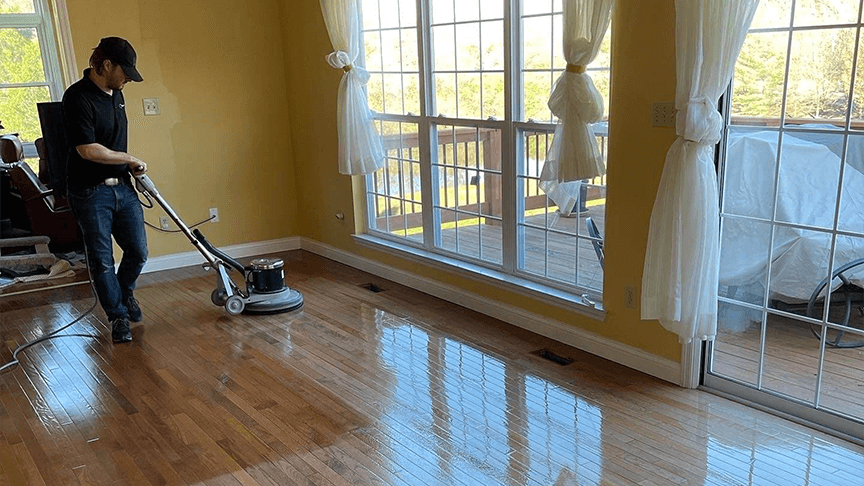
Surface preparation on engineered wood. The right method depends on the existing finish and its condition.
What makes a reasonable candidate?
A useful candidate has stable boards, sound existing finish, and wear that the proposed process can address. The color and deeper texture should already be acceptable to you.
Dullness or fine finish wear may fit that description. A dent, exposed core, delaminating layer, swollen edge, or dark stain through the surface does not become a maintenance problem merely because sanding is inconvenient.
Use our qualification guide to frame the conversation, then let an actual inspection settle the conditions. A water-drop trick at home cannot certify long-term adhesion of a new coating.
Factory finish needs a real preparation plan
Factory coatings can be very different from a finish applied on site. Some need a specific preparation or bonding system. The contractor should identify the approach and test where required.
Basic Coatings’ technical care guidance discusses options for factory-finished surfaces. The existence of a suitable system does not mean every contractor’s usual process works on every board.
If your floor has a factory aluminum-oxide finish, ask that question directly. Do not accept “we do engineered floors all the time” as the whole explanation.
Decide what imperfections you can live with
A maintenance coat can improve protection and appearance while leaving dents and deeper scratches visible. That can still be a good result. Preserving a useful floor does not require pretending it will look untouched.
Walk the floor with the contractor and identify the marks that matter most. Ask which will remain, which may look different, and which require a repair outside the coating scope.
Our scratch-depth guide helps explain those categories. For a change of color or deeper restoration, sanding and refinishing is an option only when the actual construction and remaining material allow it.
The next step is a compatibility conversation
Check the manufacturer’s warranty and care instructions before adding a third-party finish. Keep the proposed process and expected limits in the written scope.
If preserving the existing veneer is your priority, contact ReCoat Revolution about ReCoating. Include the product details, floor photos, and the marks you most want improved. That gives us a better starting point than a blanket yes or no about engineered wood.