

buyer guides
Questions to Ask a Floor Refinishing Contractor
Ask a floor contractor about diagnosis, preparation, repairs, finish, cure, and exclusions. Compare written scopes before choosing the lowest quote.
Ask why the floor needs that service before asking how much it costs
A useful floor quote starts with a diagnosis. Does the floor need cleaning, removal of an added coating, a maintenance ReCoat, deeper refinishing, or repair? Ask the contractor to explain the choice using the condition of your floor.
Then compare prices for the same work. A cheap cleaning quote and a more expensive sand-and-refinish quote are not competing bids until you know which problem each one is meant to solve.
Here are the questions we would want answered in our own house.
“What can you improve, and what will remain?”
Walk the floor together and point out the marks that bother you most. Ask which are in the finish, which reach the wood, and which cannot be assessed fully until preparation begins.
A contractor should distinguish a better overall appearance from removal of every defect. Deep pet stains, dents, color differences, and thin engineered surfaces deserve explicit limits.
The NWFA refinishing overview explains the deeper restoration category. Our ReCoat-versus-refinish guide helps you recognize when bids describe different services.
“How will you prepare and test this surface?”
Ask about product history, contamination, the existing finish, and any compatibility or adhesion checks required by the proposed system. Tell the contractor what you have used, even if it was years ago.
Basic Coatings’ maintenance checklist shows why those questions belong before application. A promise to use good finish does not answer whether it will bond to this floor.
For prefinished surfaces, ask whether the factory system changes the preparation. Our prefinished-floor article covers that narrower issue.
“Exactly which areas and tasks are included?”
Get the rooms, stairs, closets, thresholds, and stopping points identified. Clarify who moves furniture and appliances, who handles trim, and which repairs are included.
Ask how continuous areas will join untreated flooring. If you are doing one room, the color and sheen transition should be part of the scope rather than an afterthought. See our one-room refinishing guide.
A short written scope can prevent more confusion than a long sales presentation. Specific boundaries make both price and result easier to judge.
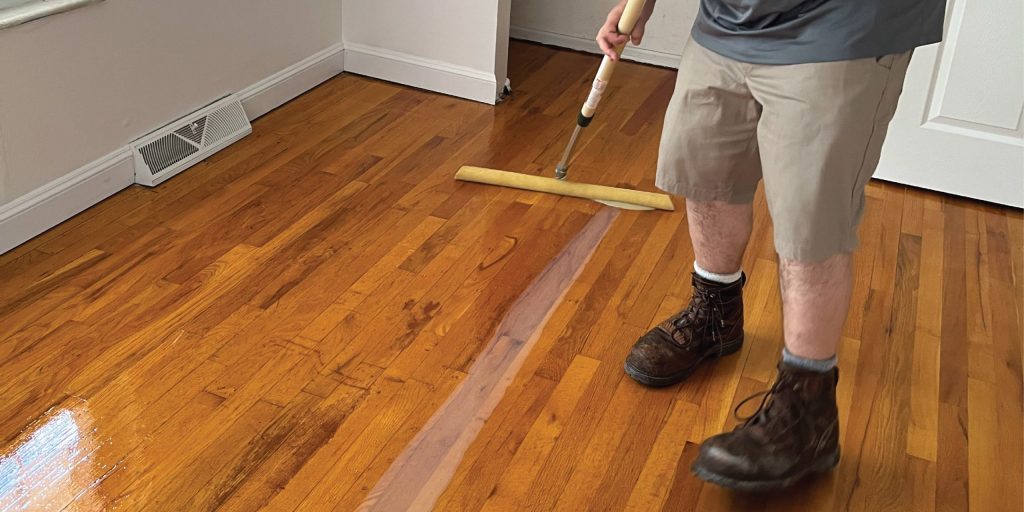
Finish application is one part of a quote. Preparation, repairs, boundaries, and aftercare also need to be defined.
“Which finish and sheen are you proposing?”
Ask for the actual coating system and the reason it suits your floor and household. Discuss samples, application requirements, and the expected look in your lighting.
The NWFA finish guide provides context for different systems. “Commercial grade” is not a substitute for identifying the product and its care instructions.
If the proposal involves changing color, ask how a sample will be prepared and approved. A swatch on another species is not a guarantee of the result on your boards.
“When can we use the house normally?”
Ask separately about walking, furniture, pets, rugs, cleaning, and ventilation. Get the instructions for the exact finish, including what happens if room conditions delay the schedule.
A one-day service description does not answer every aftercare question. Our return-to-use guide explains why those milestones differ.
Plan around real household needs. If you cannot move furniture or keep a dog off an area, say so before the work is booked.
“What happens if the floor fails a test or reveals more damage?”
Agree on the process for documenting a finding and approving any changed scope. Ask whether work stops, which options may be considered, and how costs will be explained.
Also review payment terms, responsibility for the work, and any warranty documentation before accepting the quote. Do not infer coverage from a verbal promise that everything will be fine.
For a Clean ReCoat or sand-and-refinish assessment, contact ReCoat Revolution with your goals and floor photos. We can discuss the diagnosis, limits, and scope first so the price has something meaningful behind it.