

wood floor care
Does Your Hardwood Floor Need a Deep Cleaning?
Learn when professional wood-floor cleaning may help, when dullness means worn finish, and what to ask before paying for cleaning or restoration.
Deep cleaning helps when the problem is on the surface
Professional hardwood-floor cleaning can help when ordinary maintenance is no longer removing accumulated soil or a compatible residue. It will not restore missing finish, erase dents, or pull a deep stain out of a board.
That is the first question to settle before paying for the service: is the problem sitting on the floor, or is it part of the finish and wood?
A darker traffic path can be dirt, wear, or both. A cloudy room can have residue, damaged finish, or an intentionally low-sheen surface viewed under difficult lighting. The service name alone cannot answer that.
Check the cleaning routine before increasing the strength
Start with the flooring or finish manufacturer’s care instructions. Confirm the cleaner, dilution, pad condition, and frequency. A dirty pad and too much product can keep redepositing the material you want to remove.
The NWFA maintenance guidance recommends care suited to the finish. Bruce’s care guidance likewise distinguishes suitable cleaning from products that add or leave unwanted material.
If a correct routine still leaves a problem, document it. Take photos after the floor is dry and note whether the condition appears everywhere or only in traffic areas.
Ask what “deep cleaning” includes
The phrase is not a complete scope of work. Ask which surface is being cleaned, what material is being removed, and how the process protects joints and worn areas.
If you have used a polish, restorer, or wax, tell the contractor before the quote. Removing that layer may be a separate job. Our acrylic-and-wax removal guide explains why product history matters.
A useful proposal should also describe what will remain. Existing scratches, color changes, and worn-through spots may still be visible when the removable soil is gone.
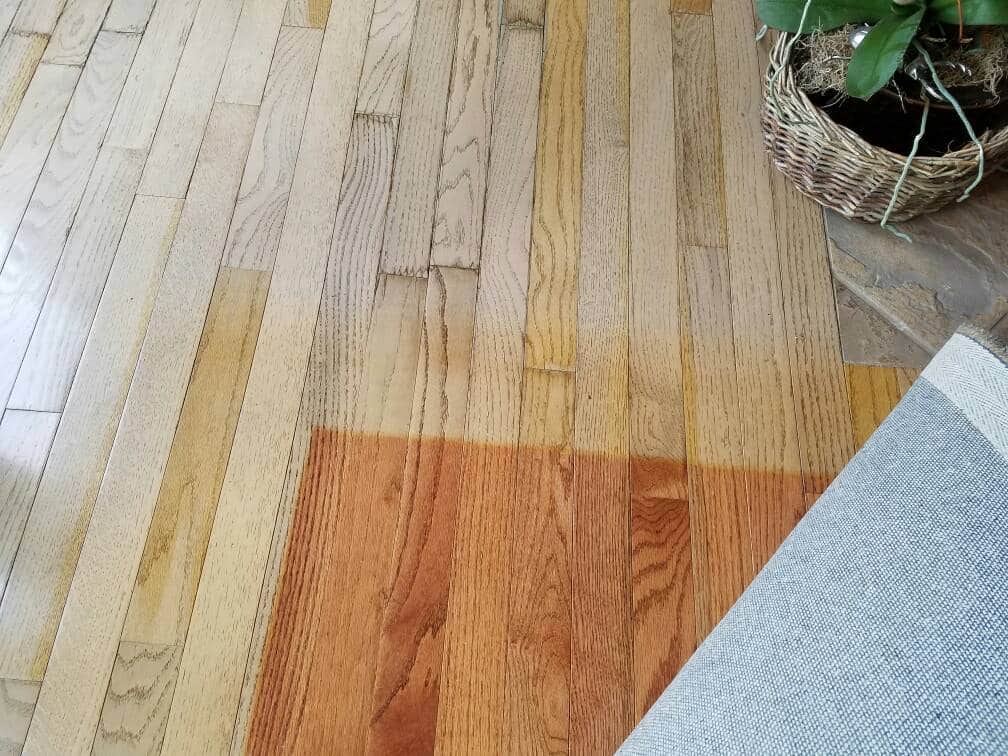
Color differences around an area rug can remain after cleaning. Ask which changes require finish restoration rather than soil removal.
When cleaning reveals a finish problem
Once residue is removed, the condition beneath it may become clearer. That does not mean cleaning caused every mark that becomes visible. A temporary layer can disguise uneven wear.
If protection is worn but the underlying finish is sound, ask whether a maintenance ReCoat is suitable. If the wood is exposed or deeply damaged, a different restoration scope may be needed.
Our cleaning, polishing, and ReCoating comparison explains these separate decisions. Do not combine them into a promise that one cleaning appointment will make every floor look newly installed.
Keep the result useful after the appointment
Ask for a written maintenance routine using the correct product and tools. Find out when cleaning can resume and whether any coating was applied as part of the service.
A professional cleaning does not create a reason to add a shine restorer afterward. If you want a different sheen, discuss that as a finish decision rather than a cleaning shortcut.
Contact ReCoat Revolution with photos, your cleaner label, and a list of any polishes used. We can help determine whether professional cleaning fits the problem or whether the finish needs a closer look.