

wood floor care
How to Clean an Oiled Hardwood Floor
Oiled wood floors need care that matches their finish system. Learn why ordinary hardwood-cleaner advice may not apply and when maintenance oil is appropriate.
An oiled floor needs its own care instructions
Clean an oiled hardwood floor with the products specified for its actual finish system. Do not borrow a polyurethane-floor routine simply because both surfaces are wood.
Also check what “oiled” means. Oil-based polyurethane is not the same thing as a penetrating oil or hardwax-oil finish. Those names describe different maintenance paths, even when the finished floors look similar.
Before buying another bottle, find the finish name on the installation record or refinishing invoice. That one piece of information can save a great deal of guesswork.
Cleaner compatibility matters here
A household cleaner may be designed to remove oils. That can conflict with the protection supplied by an oil-finish system.
Rubio Monocoat’s cleaner guidance explains this issue for its Oil Plus 2C finish. Its recommended care products belong to that particular system. They are not a universal prescription for every oiled floor, and this example does not establish which finish ReCoat uses on a project.
Bona’s natural-oil overview likewise distinguishes penetrating-oil care from other floor finishes. The useful habit is to follow the system, not the broadest label on the shelf.
Build the routine around what the surface needs
Remove loose grit before it can move through the room under shoes, chairs, or cleaning tools. Deal with spills promptly using the approved method. Keep the pad clean and avoid saturating the boards.
If the finish maker specifies a diluted soap, measure it correctly. If it offers a ready-to-use cleaner, do not assume the same dilution applies. Adding more product can create a different surface rather than a cleaner one.
Keep the cleaning instructions where everyone who maintains the floor can find them. A correct routine is not much help if a visiting cleaner uses a familiar degreaser the next week.
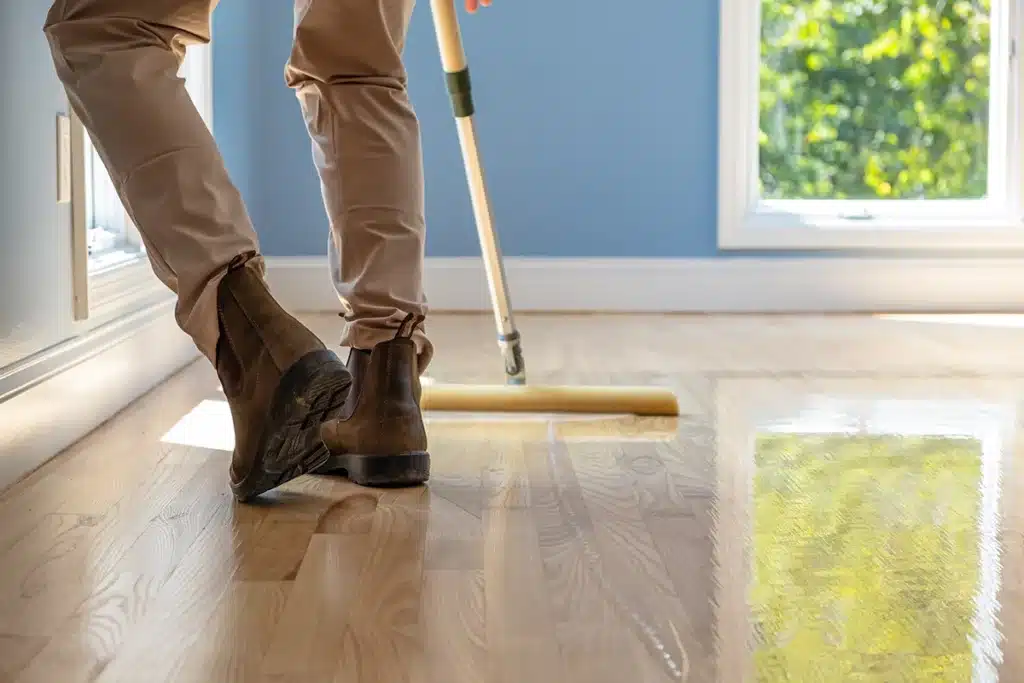
This photo shows a film finish being applied. An oiled floor follows a different maintenance system and needs its own product identification.
A dry-looking area may need maintenance, not stronger cleaning
Traffic does not affect every room equally. Look at the entry, kitchen route, and chair areas. Compare them after proper cleaning and drying rather than immediately after a wet pass.
Rubio’s floor-care guide separates cleaning, maintenance, and color repair for its own finish. That distinction is useful: a maintenance product and a cleaner have different jobs.
Do not apply cooking oil, furniture oil, or an unidentified restorer to imitate that process. Ask which compatible product is needed, how the area should be prepared, and whether the existing color can be preserved.
Keep a finish change separate from maintenance
If you want a different sheen or a film-forming surface, discuss that as a new restoration goal. It is not necessarily a matter of putting polyurethane over the current oil.
Our wax-and-polyurethane explanation shows why identifying the existing system matters before adding another. For the broader service distinction, see cleaning versus polishing versus ReCoating.
Contact ReCoat Revolution with the finish name, care products, and photos of the worn areas. If the system is unknown, say so. An honest starting point is more useful than a confident guess about which coating is on the floor.