
recoating education
How to Identify Your Hardwood Floor Finish
Find your floor’s finish before choosing a cleaner or ReCoat. Start with records, product labels, and professional assessment, not risky home tests.
Start with the paper trail, not a chemical test
The best first step in identifying a hardwood-floor finish is to find its product records. Look for the flooring model, the last refinishing invoice, or a labeled finish container. The color and shine are clues, but they are not an answer.
If records are missing, ask a qualified floor professional to assess the surface before changing cleaners or applying another coating. A home test that damages a small spot still leaves you with a damaged spot and an uncertain diagnosis.
Separate the floor from the finish
“Engineered oak” describes the flooring. “Satin” describes sheen. Neither tells you which cleaning products or maintenance coatings the surface will accept.
A factory-finished board can carry a different coating system from a floor finished in the house. A previously refinished floor may no longer have its original surface at all.
The NWFA overview of finishes explains the main categories. Film-forming finishes, wax, and penetrating oils do not share one universal care routine. The finish that is on the floor now matters more than what the boards had when purchased.
Ask for these details
Check your closing documents and home-maintenance folder. Then contact the installer or last refinishing contractor, if known. Useful questions include:
- What exact finish product was applied?
- Was the floor sanded, maintenance-coated, oiled, or waxed?
- What cleaner was recommended afterward?
- Have polish, restorer, or furniture-care products been used since?
Photograph any labels rather than summarizing them from memory. “Oil finish” can mean penetrating oil to one person and oil-based polyurethane to another. Those are different systems.
Our water-based versus oil-based polyurethane guide addresses two film-forming options. It should not be used as an oil-floor maintenance guide.
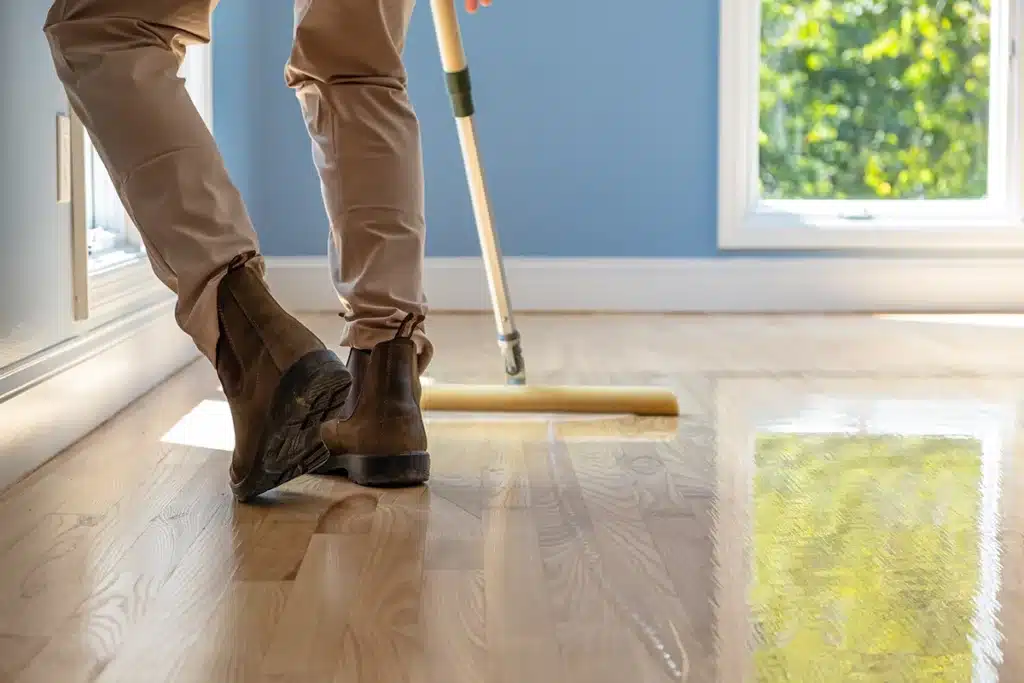
Applying a maintenance coat requires a prepared, compatible surface. Appearance alone does not establish that compatibility.
What appearance can and cannot tell you
Peeling may show a failing layer. Wear-through may reveal exposed wood. A smeared surface may suggest added residue. These observations help organize an assessment, but several causes can produce similar symptoms.
Do not scrape the floor with a coin or apply alcohol, solvent, or water just to see what happens. Internet tests often omit the possibility of multiple coating layers or an unknown maintenance product.
An inconspicuous area is not permission to use an incompatible chemical. Keep diagnostic work separate from routine cleaning.
Why this matters before a ReCoat
A new finish needs a sound, properly prepared surface. Knowing the finish family helps, but it does not establish the condition of every layer beneath it. Old polish or wax can change the scope even when the original coating is known.
Our adhesion-testing guide explains why a contractor may need a compatibility check. Our qualification guide explains the broader decision.
If your records lead to a specific maintenance system, follow that system’s instructions. If the history remains uncertain, make that uncertainty part of the estimate instead of covering it with a generic promise.
Contact ReCoat Revolution with the records you find, product-label photos, and a description of the problem. We can help determine what needs to be confirmed before choosing the next treatment.