
pet damage
Can Black Pet Stains Be Removed From Hardwood?
Black pet stains may reach below hardwood finish. Learn when cleaning, sanding, board replacement, or accepting a remaining mark makes sense.
Black pet stains can be deeper than the finish
Some dark pet-related marks can be improved. Others extend too far into the wood for cleaning or a routine ReCoat to remove. A clear coat does not erase a black stain underneath it.
The useful question is not “Which bottle removes pet stains?” It is “How deep is the damage, and what result is practical for this floor?” Odor and color also need separate attention. Improving one does not prove the other is resolved.
Our pet-damage overview covers the wider range of problems. This guide focuses on dark staining and the restoration decision.
Do not assume every dark patch is urine
A location beneath a former litter box or a history of repeated accidents is meaningful. A black patch with no history still needs investigation. Moisture, metal contact, older repairs, and other stains can produce dark areas.
Tell the contractor what you know and what you do not. Photographs help show the pattern, but they cannot measure stain depth or identify every material below the boards.
Basic Coatings’ assessment checklist includes pet stains and other existing defects. The reason to document them before work is to make the expected result explicit.
Separate four possible scopes
| Condition after assessment | Possible path | Limit to discuss |
|---|---|---|
| Removable material on sound finish | Compatible cleaning | Does not remove a stain inside wood |
| Damage within a safely removable surface depth | Sanding and refinishing | No guarantee of complete stain removal |
| Deep localized board damage | Board replacement and blending | Matching age, species, color, and texture |
| Contamination below the boards | Assessment below the flooring | A surface coating cannot reach the source |
This table is a decision framework, not a remote diagnosis. More than one scope may be needed in the same room.
Why sanding has a stopping point
Sanding removes material. It cannot continue indefinitely until a dark mark disappears. The remaining wood, board construction, earlier work, and nearby details limit what can be removed.
The NWFA refinishing guidance explains deeper restoration as a different job from maintenance. Our engineered-floor guide covers why the available surface can be especially limited on a layered product.
Ask what happens if a test area still shows discoloration. A responsible scope includes that possibility before the crew has spent the floor’s remaining sanding allowance.
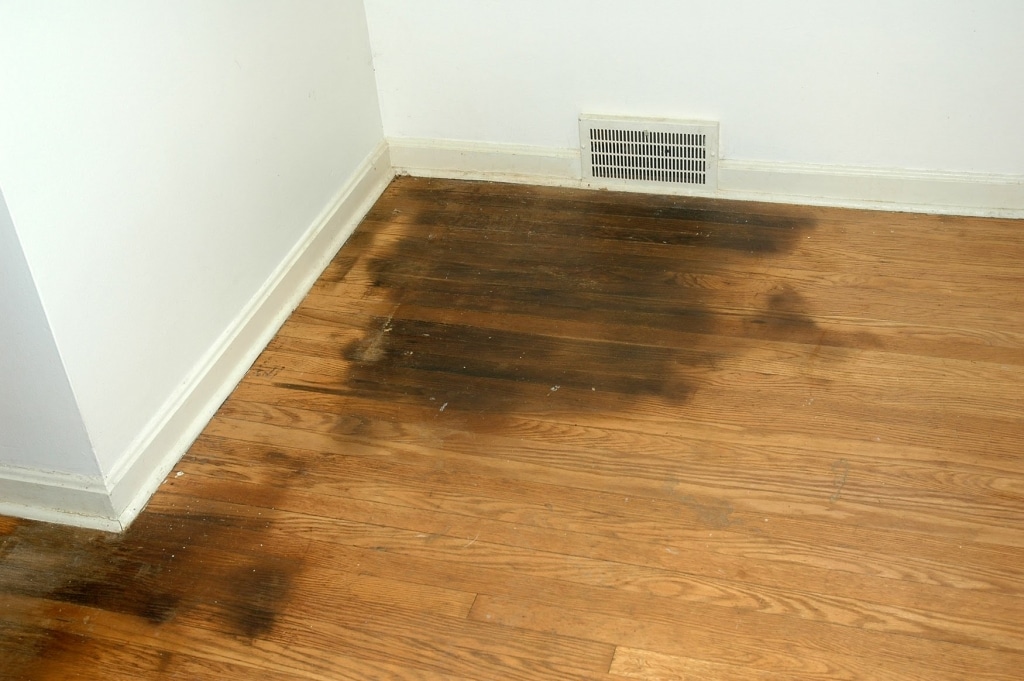
Dark staining across several boards. The depth of a mark determines whether cleaning, refinishing, or board repair can help.
Darker stain is a design choice, not a cleanup certificate
A darker color may reduce the contrast between damaged and unaffected wood. It may also produce a result you do not like in the rest of the room. It does not prove that an odor source or contamination below the surface has been removed.
Review a representative sample after the proposed preparation. Ask whether the marked boards will remain visibly different. If you would be unhappy with that result, discuss replacement before coating the room.
Bruce’s hardwood FAQ includes board replacement among repair options. It is worth considering when a small number of deeply affected boards would otherwise dictate an aggressive treatment for the entire floor.
Avoid soaking the area with a homemade remedy
Do not saturate the wood with peroxide, bleach, or a succession of cleaners because an online photo looked successful. You can create a new color mismatch or drive moisture farther into joints.
If a pet-care cleaner is being considered for a fresh accident, its instructions must permit the exact floor finish. Repeated old stains are a restoration question, not permission for longer soaking.
Our scratch-depth article explains another common pet issue, but scratches and urine staining should not be bundled into one promise.
Ask for an honest floor plan
A ReCoat may suit unaffected areas with sound finish. Sanding and refinishing or board repair may be appropriate elsewhere. The transitions and final appearance need planning together.
When you contact ReCoat Revolution, describe the history, whether odor remains, and where the stains sit. Send a wide room photo and close views. We will start with what can be improved and what may need replacement or acceptance, rather than promising every black mark will vanish.